
Building Thoreau's Cabin
When the dream becomes the path

“If you have built castles in the air, your work need not be lost; that is where they should be. Now put the foundations under them.” — Henry David Thoreau
My mom handed me her childhood copy of Walden when I was fourteen. I have always been blessed with a photographic memory and recall the scene vividly. But I can only recall one sentence from our conversation. “This is one of the most important books you will ever read.”
Indeed.
Walden is fertile ground to explore at any age, but Thoreau’s words resonated with me like nothing I’d ever read. Living at the edge of a splendid New England pine forest helped me relate on a tangible level to be sure. Every day I got off the school bus, changed clothes, and ran out the back door to explore the verdant world beneath the pines. Thoreau’s observations of the flora and fauna around him literally hit home.
But his cabin undertaking was the clincher.
The idea of living “off-grid” was audacious for its time. So much so, that many of Thoreau’s acquaintances thought he was nuts. “What will you eat?” “Aren’t you afraid?” “Won’t you be lonesome?”
In response, Thoreau opined that maybe it was his well-intentioned contemporaries who should question how they lived instead. After all, Henry would be living in a humble, quite adequate shelter, free from debt with nature’s thrall as his companion. Conversely, most of the people questioning his intentions were trapped in the cycle of the acquisition and maintenance of possessions, and the toils of labor required to pay for them. “Lives of quiet desperation.”
Now who was crazy?
The path Thoreau was blazing was adventurous, but not reckless. Like any worthwhile journey, its purpose was well defined, and its day-to-day itinerary less so. If room isn’t provided for discoveries, pitfalls, reflection, insights, and changes, the trip will be doomed before it leaves the doorstep.
I had no idea how prophetic my mother’s words would be — how impactful Thoreau’s work would be on my life — but I was compelled to find out. Fifty-five years later, I have a good idea.
Adventurous, but not Reckless
The dream took shape in my late teens. In my experience, the difference between a dream and an idle thought is that a dream requires action to take root. Idle thoughts are like seeds in a packet. They can sit dormantly in your mind for months, years, decades — right up until the day you die in fact. Action is the soil, sunlight, and water dreams need to take root.
What I knew from my late teens until my late sixties was that someday I wanted to build a Thoreau inspired cabin in the woods, a place where I could reap the benefits of nature and solitude and work on my writing.
During those years, I never lived in a place where I could make it happen. I was living the life of one of Thoreau’s villagers. A life of quiet desperation in a world of incessant noise, living anything but the life I imagined. But one thing I did have was a king-size packet of seeds.
Over four decades, I assembled a collection of cabin plans that filled a file drawer and a bookcase shelf. What form my Thoreau cabin would take was completely TBD. Would it be straw bale? Post and Beam? A treehouse? Passive solar? Constructed from a kit? The mouth of the funnel was as wide as could be. I just kept filling it. Tear sheets from magazines, full-blown blueprints, hardcover and paperback books, and even plans I drew myself. Once in a while, I’d cull out the definite losers or those past their expiration date (some of the kit companies went out of business over the years).
Something Miraculous This Way Comes
Three years ago, the dream of building Thoreau’s cabin transformed into something entirely unexpected. It became the path.
My partner and I were driving through rural western Maine, informally looking for a piece of land and thinking we might have gone just a bit too far down a dirt road when we spied a “For Sale” sign nailed to a tree. We parked the car and bolted into the woods to check the property out. It was spectacular. Perched on the lower slopes of a mountain, the 6.5-acre completely wooded parcel included two streams, two ridges filled with hemlocks, birches, and pines, and the intoxicating allure of complete solitude.
Sold!
Back in the city, I began rethinking my plan for the Thoreau cabin. I now realized that all the plans I’d accumulated over decades — that giant packet of seeds — had completely expired. I wasn’t interested in building any of them. I was now fixated on building a cabin based on Thoreau’s own design.
But where to start? I had no floor plan and practically no experience as a carpenter. I wasn’t sure there was anything to go by other than Thoreau’s description of the cabin. Turns out, I was lucky. An amateur archeologist named Robbins discovered the site of the cabin in 1945 (one hundred years after Thoreau’s first year at Walden Pond). Robbins drew a set of blueprints based off the chimney and foundation locations and I was able to get my hands on a copy.
While still living in the city, I was able to procure two 12-pane windows, like Thoreau’s originals. (Even in New England, it’s hard to find “12 over 12” windows anymore.) I also spent the month of February building a replica of Thoreau’s desk. The dream was no longer a concept. It was taking form.
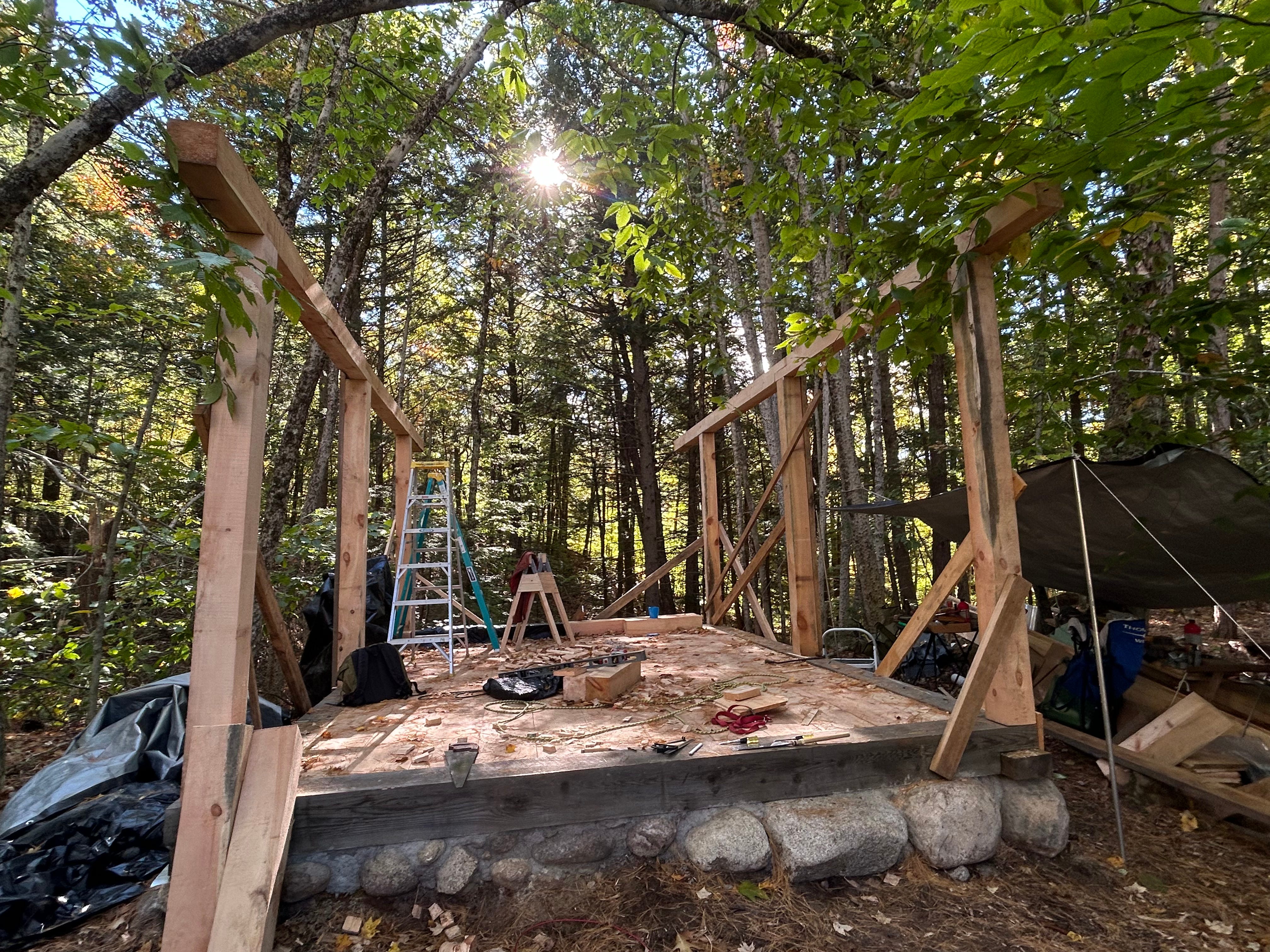
Last summer, we were living in a new post and beam house that we had built on our property. Fortuitously, there were several piles of lumber left over — 16-foot lengths of wide, shiplap pine, rough-sawn 2x8s and 2x6s, and, best of all, 12-foot 12x12 hemlock beams. It was time for action.
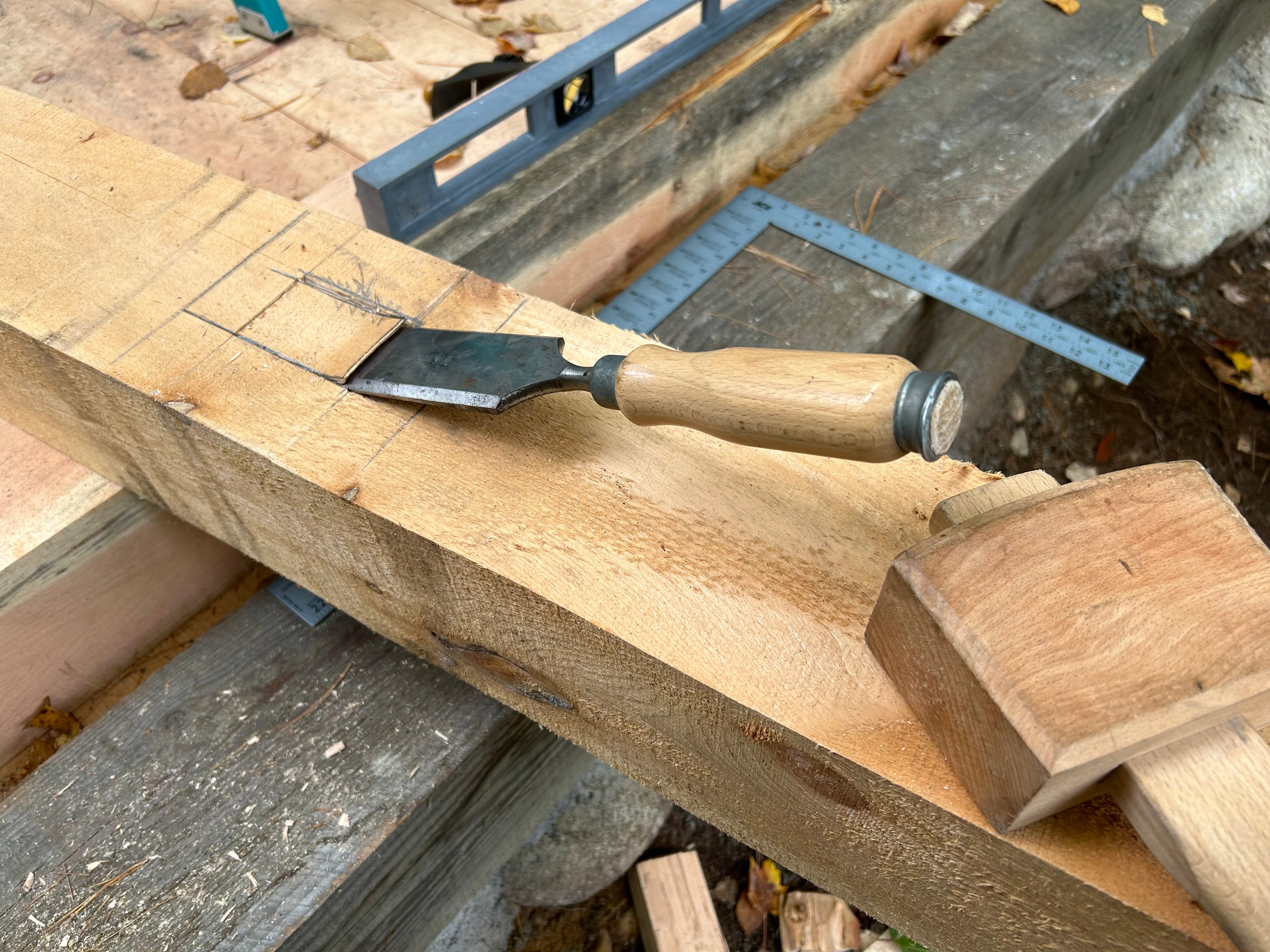
The journey has been incredible — with a purpose well-defined and a day-to-day itinerary less so, how could it not be? Most days, it was just me, with my beloved dog by my side, marking and cutting mortises and tenons, fitting pieces together, and watching a cabin take form. It’s deliberate, immensely satisfying work.
When my cabin is complete — in the days after that last trowel full of plaster is smoothed out on the wall. When I’m sitting a my writing desk, listening to a barred owl singing, “Who cooks for you?” into the autumn night, I’ll give a little nod toward the stars and thank both my mom and Henry David Thoreau for encouraging me to live the life I have imagined.
One of our favorite kids books is called Henry Builds a Cabin. And not just because we’ve got a penchant for the name Henry. HDT’s cabin is perfect for its inadequacies. The small rooms provide an excuse to spill out into it the landscape that surrounds the building. Love this book and its lesson to build just enough but not too much, because the space we really need is out of doors.